Dearest Gentle Reader,
Last month, I had the privilege of watching Ballet Manila’s production of “Swan Lake.” 🦢
If you wish to watch their next show “Florante at Laura” in October, please do use my discount code: BMPEARL30
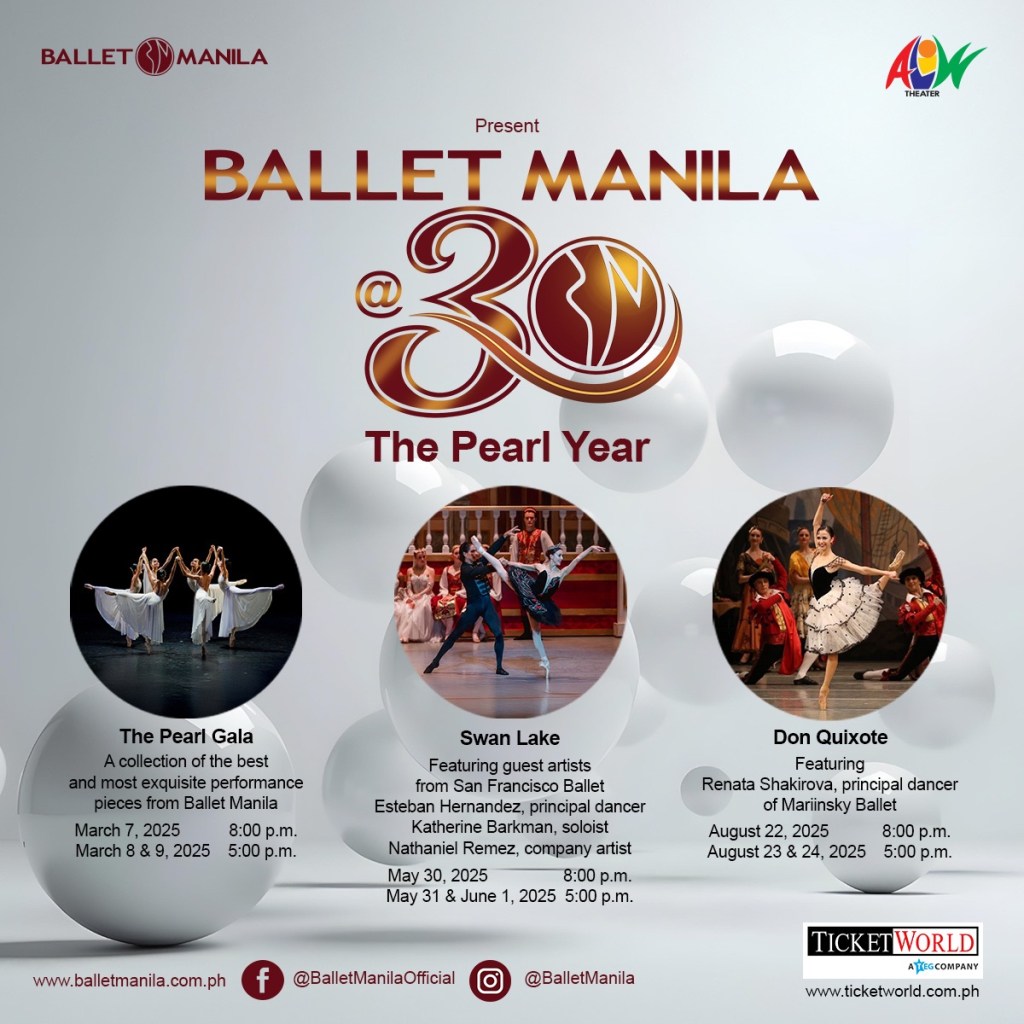

It was the May 30 show on a Friday, so my friend Valerie and I (after 30 minutes of booking) were forced to call a taxi, braving the mortifying Friday Makati traffic.
After miraculously making it in time for the entrance of the ballet de corps, we huddled in our seats as excited first time ballet watchers… and were promptly introduced to a glistening world of beauty, dance, and romance.
A PRELUDE
As 21st century folks, we had a very hard time convincing anyone else to watch with us since ballet has no dialogue and is purely danced through – but push through we did, and it was completely worth it, proving the timeless appeal of the classics.
For context, the first production of “Swan Lake” was over 200 years ago in Moscow on March 4, 1877; squarely in the Victorian era!
Though not a single word was spoken on that stage, the story and emotions were conveyed richly through disciplined dance moves and precise gestures.
Tchaikovsky’s soaring score with its crown jewel, the iconic oboe-laden main theme) delights and entrances, instantly conjuring the elegant images of a serene swan floating across magical waters.
REVIEW
From the show’s first arabesque, we were whisked away to 1895, one of the most influential revivals of “Swan Lake,” which is the base of most modern performances of the ballet.
This specific production used the original choreography by Marius Petipa and Lev Ivanov, which was such a treat for our classic-loving souls. All the key moments I was looking forward to such as the Black Swan’s 32 fouettés, the Dance of the Little Swans, Odette & Siegfried’s Pas des Deux, and more – were preserved.
It warms my heart to see that the choreography created more than a century ago by a Russian Balletmaster in Moscow is being done today, more than 11,000 kilometers away across the sea; proving how the arts can transcend time, distance, and cultural difference.
Note that the show is not an extract replica! According to the Ballet Manila Archives, this version incorporates their own interpretations and improvements, such as a clearer storyline and enhancements to the corps de ballet and solo performances.
I shall evaluate each Act of the ballet as follows:
- Set & costumes
- Audience reactions
- Personal thoughts
And then move onto my analysis of why the classical arts are so timeless in today’s nostalgia-loving culture.
ACT I: THE KINGDOM
The magnificent court of the King and Queen, serene and idyllic, featuring grandiose roses and costumes of green and pink onstage.
Court scenes 🌷
- The soloists were amazing, full of power and grace
- King and Jester serve as comic relief in between bouts of dancing.
- The queen’s entrance, and a sweet gift to her son. (She is a non-dancing character, which makes sense considering she’s the only one wearing a giant ballgown that trails behind her in a most grandiose manner)
After about thirty minutes of magnificent dancing, there was nary a single swan in sight. My friend and I were beginning to think: was this even the right show?
The Pas de Trois (Dance for three soloists) and Prince Siegfried’s Solo were lovely to watch!
ACT II: The Lake
Then the iconic “Swan Lake” theme kicked in, filling us with extreme excitement. As the Prince rushed upstate, bow in hand, a flock of swans flew across the screen. My, what a tease!
When the curtain opened, we were finally able to lay our eyes on Swan Lake: dark blue and mysterious, with fog pooling at the center of the stage. What we saw next was not an elegant swan, but a sight that made my friend jump in her seat – it was Von Rothbart, the owl-sorcerer, spreading his wings in a dark costume, worthy of a Fae King. His performance was powerful: sheer physicality and stage presence, as he practically set the stage on fire.
When Odette appears, she is delicate and ephemeral, a powdery vision of white lace and tulle upon the stage. The way she shrinks away from Siegfried at first, then slowly opens up to him and dances with him is so moving to watch; and their chemistry was sumptuous!
I shall not neglect to mention the divine harp glissandos as the swans melt away from the prince’s approach, like reeds on a pond. It was a breathtaking illusion, created by the combination of dance, lighting, and music. It was a sight that solidified ballet in my mind as portraits in motion – extreme idyllic beauty and the human body elevated to as art itself.
Dance of the Little Swans was delightfully adorable!! Amazing coordination while their hands were linked the entire time.
We were treated to a beautiful sequence of dances by the Swans, with solo and duo performances from Odette and her fellow maidens.
The discipline of the ensemble was riveting, as they had to hold their poses for up to two minutes or more at a time. It made us imagine a character in the corps de ballet in corps de ballet, and how we’d yearn for a principal role if we were there.
Siegfried’s pledge of love and him elegantly kissing her hand was a huge highlight for us!
ACT III: The Royal Ball
Time for the Prince’s ball!
After a spectacular intro, the act began with a delightful pas de six featuring princesses with feather fans.
I recall how the crowd went “ohhhh…😟” when the prince rejected one of the princesses.
The ff. were also a treat to watch!
- National Dances (
- Spanish Dance
- Hungarian Dance (Czardas)
- Neapolitan Dance
- Mazurka
Rothbart’s party of matadors were a sight to behold, as he reentered with a human disguise and of course – his daughter Odile!
Black Swan Pas de Deux (Siegfried and Odile – “faux Odette”)
The moment the black swan entered, you could hear a pin drop – as if it was a scandal in real life!
Her movements were forceful, unlike Odette, and the 32 fouettés were marvelous! (Valerie and I counted them with bated breath)
We held hands in dread the moment the white swan appeared at the window, distressed and trying to warn Prince Siegfried of the deception. It was heartbreaking!
- Siegfried’s Betrayal (He swears to the wrong woman)
Siegfried runs out the gates as the entire ensemble and the queen in the center, stumbling backwards and fainting as they realize they’ve been tricked.
ACT IV. The Denoument
Crestfallen, Odette returns to the lake.
The following sequence was a sight so beautiful it moved me to tears: the swans surrounding Odette, dancing gracefully as our heroine falls into a delicate pose, her head falling softly into her hands – pure white costume glittering as the stage turns dark and a singular spotlight falls on her.
It was a Renaissance painting brought to life, and my eyes wept accordingly.
After the lovers leap into the Lake, all seems lost… until their spirits rise from the waters in Apotheosis (deification), freeing all the other swan maidens.
Watching Siegfried and Odette fly across the stage on the sun itself was so intensely beautiful, everyone stood up and started applauding.
POST-SHOW REVIEW
This ballet has been performed since 1877, yet still continues to move audiences over a century later!
In this time of nostalgia and looking back, it’s easy to see why the classics are looked back on with rose-colored lenses. Most people fall into one of two camps: “oh, art was so much better back then” or “art was so boring and stuffy.
For this writer, it’s more than that: the classics give us a sense of continuity, remind us that art has always been made, and that art has always been a reason to live – like beauty and love.
So as you continue listening to classical music, watching Shakespeare, or attending an evening at the ballet (or even a concert!) – always remember that the same timeless things that moved us humans then still do move us now.
Thank you so much for reading!
 Milo Moone
Leave a comment